
| Reading does more for a child than build a bigger vocabulary. It changes how their brain wires itself for language and gives them the raw material to understand every other school subject. It shapes focus, empathy and confidence. The benefits of reading for children compound over years, but they depend on two things parents control – how you read together and whether reading becomes a daily habit. This guide covers the evidence, the age-by-age picture and the practical methods for reading habits for kids that actually last. |
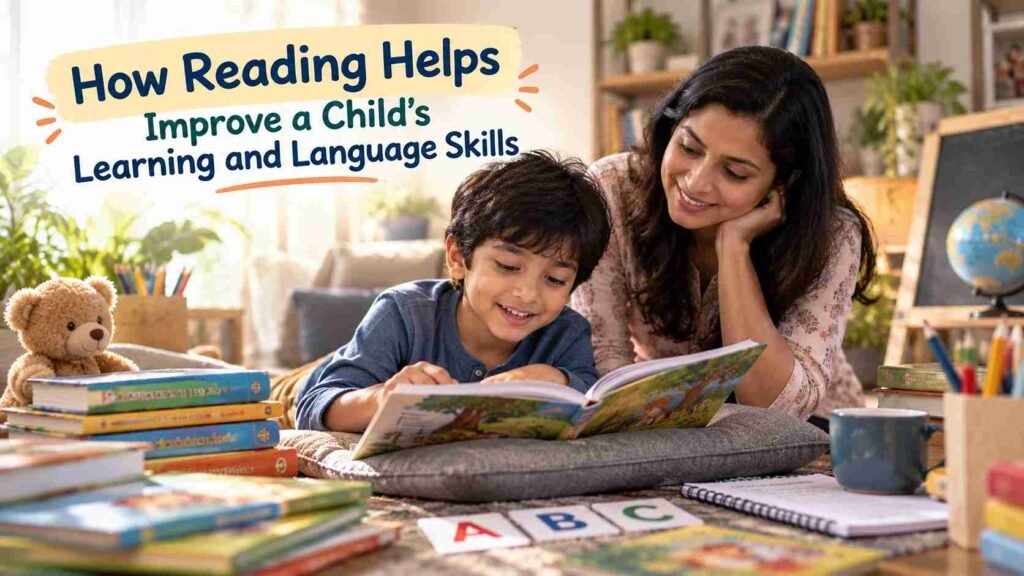
Most parents already believe reading is good for their child. What they rarely get is a clear picture of why it works, how much of a difference it makes and what to actually do beyond “read every night.” The result is a lot of half-finished bedtime routines and shelves of untouched books. This article connects the two things usually kept apart: the research on reading and language development and the ordinary, doable habits that put that research to work at home. You don’t need to be a teacher to use any of it. Scroll and learn the details.
How does reading improve a child’s learning and language skills?
Reading floods a child with more words, more complex sentence patterns, and far more knowledge than conversation alone ever could. It strengthens the neural networks that both spoken and written language depend on. Since nearly every school subject gets taught through language, kids with strong vocabulary gain an edge that extends across every class. The basic mechanism is simple: reading feeds language, and better language makes everything else easier to learn. The practical gains stack up quickly.
- A child who reads encounters many more words per week than a child who only listens and sees how those words actually fit together in context.
- Books offer facts and background knowledge that make new lessons click faster.
- Reading also trains attention and memory, building the mental stamina to follow a line of reasoning across paragraphs or chapters.
- And there’s a flywheel effect: kids who read well tend to enjoy reading, so they read more, which makes them better at it, which makes them want to do it again.
Why reading builds language faster than everyday talk
Reading accelerates language because books expose children to words and structures that simply don’t come up in daily speech. A conversation about dinner uses a small, familiar set of words. A picture book about the ocean or a dragon or a grandmother’s village reaches for rarer, more varied language, which is exactly what a growing vocabulary needs. This is why regular reading outpaces even a chatty, loving home on the specific job of language growth.
- Children’s book reading sessions are more lexically diverse than standard caregiver-child conversations, exposing children to words they otherwise wouldn’t hear, confirms a PubMed research.
- Around a quarter of caregivers never read with their children, so the difference between homes is large.
- Talk around the book, be it questions, side comments, connections to real life. It adds even more words on top of the text itself.
The word gap between children who are and aren’t read to
The difference in word exposure between read-to and not-read-to children is measured in the hundreds of thousands and it is present before school even starts. A widely cited Ohio State study modelled how many words children hear from books alone by age five and the spread is dramatic. This early gap helps explain why some children arrive at school already primed to read while others start behind.
Some interesting facts are:
- Never read to: roughly 4,662 words; read to daily: about 296,660 words by age five.
- Five books a day adds up to roughly 1.4 million more words than a child who is never read to.
- Even one book a day means about 290,000 more words heard by age five. It can be a small nightly habit with an outsized effect.
Why book words do the heavy lifting
Book words matter more than sheer talk. Reason? They are more advanced and more varied. Also they are more like the language of school and print. When a child later meets those words on a page, they recognise them, which makes learning to read faster and smoother. The words heard at bedtime become the words decoded in a Class 2 textbook.
- Children who hear more vocabulary are better prepared to see those words in print. They tend to pick up reading skills more quickly and easily, confirms Ohio State University.
- Rare and abstract words (the kind that appear in exams) show up far more in books than in conversation.
- Rereading favourites reinforces the same rich words until they stick.
How reading shapes the developing brain
Reading with young children physically strengthens the brain systems used for language and literacy, an effect visible on brain scans before a child can read a single word. Being read to isn’t just pleasant input; it appears to build the neural “wiring” that later reading depends on. This is a large part of why professional bodies push reading from the very start of life.
- Brain-imaging work found that preschoolers exposed to more reading at home showed stronger activation in areas supporting language and mental imagery while listening to stories, helping them “see” the story.
- A richer home reading environment was linked to better-organised white matter in tracts that support language and emergent literacy, such as the pathway connecting the brain’s main language regions.
- By contrast, higher screen-media use was associated with less-developed white matter in areas important for language and literacy
The wider benefits of reading for children
Beyond vocabulary and grades, the benefits of reading for children include empathy as well as emotional wellbeing. They develop a broader understanding of the world. Stories let a child step into someone else’s experience. This builds the social and emotional muscles that formal lessons don’t teach. These soft gains turn out to be strongly linked to the hard ones.
- Empathy- reading fiction is associated with greater awareness of the world and stronger empathy.
- Wellbeing- children most engaged with reading are around three times more likely to have higher mental wellbeing than the least engaged.
- Confidence and knowledge- reading widens general knowledge and self-belief and non-fiction sparks new interests and curiosity.
- Attention and stamina- sustained reading builds the ability to concentrate for longer, a skill that transfers to every subject.
How reading improves learning across the school years
Reading improves school learning because comprehension and vocabulary are the tools every subject is taught with and because reading and language feed each other in a loop that widens over time. A confident reader understands word problems in maths, instructions in science and sources in history. A struggling one is held back everywhere, not just in language class.
- Reading for pleasure predicts attainment- it is linked to higher scores in vocabulary, spelling and mathematics and is more strongly tied to cognitive progress in adolescence than parental education
- International data agrees- in PISA findings, engagement in reading is strongly correlated with reading performance and helps offset gaps tied to background
- Enjoyment compounds skill- children who enjoy reading are about twice as likely to have above-average reading skills as those who don’t (34.2% vs 15.7%)
- The loop runs both ways- reading builds language, stronger language makes reading easier and the early gap between strong and weak readers tends to widen with age unless addressed.
Reading and language development, age by age
Reading supports language differently at each stage. So, when we say reading together helps, things change in terms of how it should look as the child grows. The goal shifts from sound and closeness in infancy. It later moves to comprehension and independence. Matching the approach to the age keeps reading enjoyable too.
Birth to 2 years
At this stage reading is about sound, rhythm and connection, long before the child understands the words. The point is exposure and warmth, not comprehension.
- Choose sturdy board books with simple images and repetitive, rhyming language.
- Name objects, make sounds and let the baby touch and turn pages.
- Keep sessions short and frequent rather than long.
3 to 5 years
This is the peak window for vocabulary from books, so read daily and talk around the story. Picture books with richer language do the most work here.
- Ask simple questions about the pictures and what might happen next.
- Reread favourites; repetition is how new words get locked in.
- Let the child “finish” familiar lines and point out letters they notice.
6 to 8 years
As the child starts decoding print, reading becomes a shared, two-way activity. Keep reading aloud even after they can read alone.
- Take turns reading pages so effort is balanced and fun.
- Discuss meaning, not just accuracy. Ask why a character did something.
- Introduce simple chapter books and let them choose topics they like.
9 years and up
The aim now is independence and range, with reading as a genuine leisure choice. Your job shifts from reader to enabler.
- Give free rein over choices, including comics, magazines and non-fiction.
- Keep talking about books together to sustain the habit socially.
- Model reading yourself; children copy what they see adults value.
How to read with your child so it actually helps
How you read matters as much as how often. The most effective method is to let the child talk while you listen, prompt and build on what they say. This interactive approach, known as dialogic reading, turns story time from a monologue into a conversation. It is simple enough to use at home with any picture book.
- In a controlled trial, children read to this way for just four weeks scored significantly higher on expressive vocabulary, an advantage still present nine months later.
- The core routine is the PEER sequence: Prompt the child to say something, Evaluate their answer, Expand it with a little more, then Repeat the prompt.
- Vary your prompts using CROWD: Completion, Recall, Open-ended, Wh- questions and Distancing (linking the story to the child’s own life)
- Keep it light. Don’t quiz on every page; if the child just wants to listen, let them.
How to build child reading habits that last
Lasting reading habits for kids are built through routine, easy access to books and protecting reading from feeling like homework. Enjoyment is the engine. Children who read because they want to are the ones who keep reading and get the benefits. The parent’s job is to remove friction and add pleasure, not pressure.
- Make it a fixed daily slot, usually bedtime, so it becomes automatic rather than a decision.
- Give real choice, including formats adults sometimes dismiss; comics, magazines and audiobooks all count and often hook reluctant readers.
- Keep books within reach at home and use the local library so cost is never the barrier.
- Protect the fun: avoid turning reading into a reward-and-test system and let a disliked book be abandoned.
- Be a reader yourself. Research suggests a child’s interest in reading matters more for building skills than whether a parent holds a degree and interest is caught from the people around them.
Print versus screens: does format matter?
For young children, print reading with a parent generally does more for language than screen-based reading, mainly because it invites more interaction and less passive consumption. Screens aren’t banned from a reading life, but for the youngest children the shared, physical bookhas an edge the research keeps pointing to. As children grow, quality and engagement matter more than the medium itself.
- Print picture books tend to prompt more back-and-forth talk than swipe-and-tap e-books, which is where much of the language gain lives.
- Heavy passive screen use in early childhood has been linked to weaker development in language and literacy brain areas.
- For older, independent readers, an engaging e-book or a well-chosen audiobook still builds vocabulary and comprehension.
- Whatever the format, the interaction around it (questions, discussion, shared attention) is what drives the benefit.
To Sum Up
Reading builds language. Books flood children with more words, richer patterns and varied knowledge than speech alone. This strengthens the neural networks language depends on. Kids gain an edge across every school subject. Start early. Read daily. Keep it fun. The gap between readers and non-readers opens by age five. It widens with time unless addressed. When children enjoy reading, they read more. They get better at it, learn faster in every subject and make it a habit. Protect the pleasure. The returns compound for years.
FAQs
My child can already read independently, should I stop reading aloud to them?
Ans. No. Keep reading aloud. You can read above your child’s current reading level, introducing words and stories they wouldn’t tackle alone. It also keeps reading something you do together rather than solo work, which matters in the years when kids naturally pull away from books.
What if my child strongly resists reading?
Ans. Separate reading as a skill from reading as pleasure, then fix the pleasure first. Stop pushing “good books” and follow what they actually want: comics, joke books, whatever. Read with them, not to them. Don’t test comprehension. Since enjoyment is the strongest driver of whether kids read more and read better, making it fun usually works better than any amount of pushing.
Does the language of the book have to be English to get these benefits?
Ans. No. Kids build language skills in their first language the same way. A strong foundation in one language helps them learn others later. Reading in whichever language you speak best means you’ll have better conversations around the story. That matters more than which language you pick.
How much daily reading is actually enough to make a difference?
Ans. Consistency matters more than length. A single book a day, read regularly, delivers real gains. A 10-to-15 minute session most days works far better than sporadic longer sessions. You can do it without it becoming a battle.
Will reading really help my child in maths and science, not just English?
Ans. Yes. Every subject gets taught through language. Word problems, instructions, test questions all rely on reading comprehension. Kids who read well understand what’s being asked. That’s why reading for pleasure shows up in higher maths scores, not just English scores. It’s a tool for learning everything.