
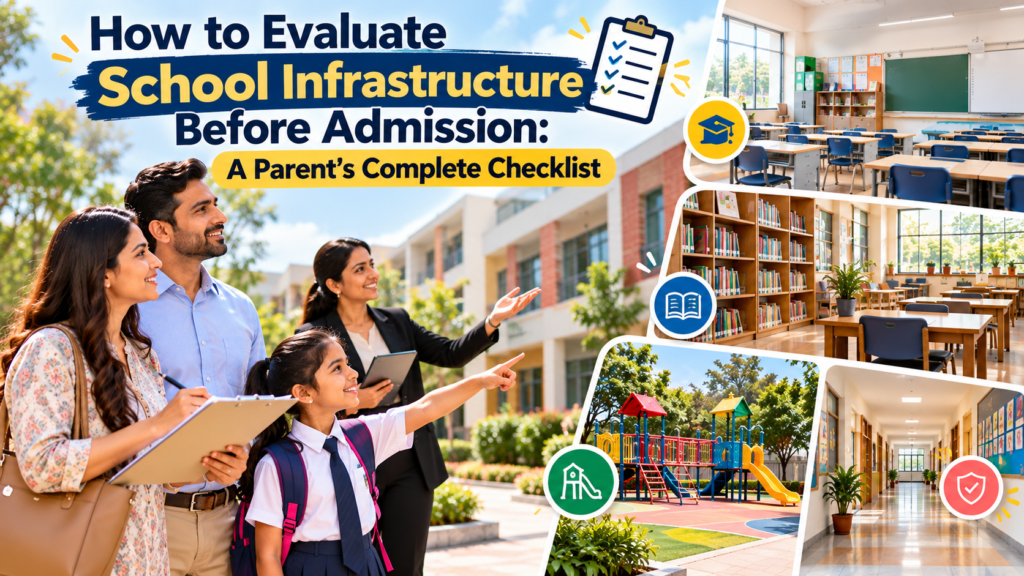
Good school infrastructure is not the shiny building you see on the tour. It is the everyday, working condition of classrooms, labs, washrooms, safety systems and open space that your child will actually live with for years. Before you commit to an admission, evaluate five things- functional learning spaces, real safety systems (fire, building, transport, CCTV), clean and adequate sanitation, honest accessibility for every child and proof that the school meets legal norms. This guide gives you a school infrastructure checklist.
Most admission decisions get made in a 20 to 30 minute campus tour, guided by someone whose job is to impress you. That is a hard place to judge whether school facilities will serve your child on an ordinary day in July, when it is raining, the labs are booked and 40 children need a working washroom. Parents are told to “check the infrastructure,” but rarely told how, which questions to ask, which certificates to demand and which impressive-looking facility is quietly useless. This article turns a vague instruction into a working method, so a short visit still tells you what you need to know.
Why school infrastructure deserves a hard look before admission
School infrastructure matters because it is the physical setting in which learning, safety and daily comfort either happen or don’t. And unlike a teacher or a syllabus, you cannot easily change it after you enrol. A cramped, poorly lit, badly maintained campus quietly drains attention and wellbeing every single day, while good facilities give practical, hands-on and physical learning somewhere to actually take place. The infrastructure you accept at admission is the environment your child inherits for the next several years.
- It is the one factor that is largely fixed once you join; teaching quality can improve, a broken building rarely does mid-year.
- It signals the management’s priorities- schools that maintain toilets, labs and safety systems tend to run other things carefully too.
- Poorly maintained basics (water, sanitation, unsafe buildings) remain a real problem in Indian schools despite headline progress, which is exactly why parents should verify rather than assume. School protests across several states in 2026 highlighted gaps between legal promises and reality on classrooms, water, sanitation, electricity and safe access.
What counts as school infrastructure?
School infrastructure is the full set of physical facilities, safety systems and support spaces a campus provides, not just the classroom block. It spans learning spaces, laboratories, library, sports and open ground, sanitation, digital setup, transport and the safety and accessibility features that make all of it usable. Thinking in these categories stops you fixating on one glossy feature and missing three broken essentials.
- Learning spaces- classrooms, activity and art rooms, quiet corners
- Specialist facilities- science and computer labs, library, sports and music
- Health and hygiene- washrooms, drinking water, kitchen or canteen, medical room
- Safety and security- fire systems, boundary wall, CCTV, transport, emergency plans
- Access and support- ramps, accessible toilets, staff and admin spaces
The core school infrastructure checklist
The core checklist is a room-by-room, system-by-system inspection of whether facilities exist, work and are used, not just whether they were built. Walk each space below and judge condition and function, not appearance. Below, each sub-area gets its own quick test.
Classrooms and everyday learning spaces
Classrooms are the space your child occupies most, so they carry the most weight in any school facilities review. Check that rooms are genuinely lit, ventilated and uncrowded, because these ordinary conditions shape concentration far more than a smart board on the wall. As a benchmark, CBSE norms specify classrooms of roughly 8m by 6m with at least one square metre of floor area per student and an optimum of around 40 students per section
- Count desks and imagine the class full. Does each child have room to move and be seen?
- Look for natural light and cross-ventilation, plus working fans, lights and power points
- Check walls, ceilings and floors for damp, cracks or obvious neglect
- Notice whether displayed work is current or dusty, a small sign of whether the room is alive or staged
Laboratories, library and activity rooms
Labs and libraries should show evidence of regular use, not just existence, since a locked or under-stocked facility adds nothing to school facilities for students. Open a cupboard, ask when the space was last used and look for the wear that comes from real activity. CBSE expects a composite science lab at the secondary stage and separate Physics, Chemistry and Biology labs at the senior secondary stage, plus a library of roughly 14m by 8m.
- Ask how often each grade actually uses the labs and whether experiments are demonstration-only or hands-on
- In the library, check for age-appropriate, current books and whether children are allowed to browse and borrow freely
- Look for chemicals, apparatus and computers in working order, not decorative displays
- Ask about supervision and safety protocols in labs and activity rooms
Playground, sports and open space
Open space and sports facilities protect a child’s physical health and daily release, so they belong on any serious checklist rather than being treated as a luxury. Confirm there is real, usable ground, not a token strip between buildings. CBSE norms call for an athletics ground with at least a 200-metre track along with provision for common games.
- Check whether outdoor space is genuinely available for all grades or shared so thinly that most children rarely use it
- Look for indoor options for monsoon and extreme heat
- Note equipment condition and whether PE appears timetabled, not optional
- Ask how many periods a week your child would actually spend outdoors
Washrooms, drinking water and hygiene
Sanitation is the single most revealing part of a campus, because it is the facility schools most often neglect and the one children use every day. Insist on seeing the toilets children actually use, not a display washroom near the reception. Adequate, clean, separate toilets and safe drinking water are legal minimums, not extras.
- Check that toilets are functional, clean and genuinely separate for boys and girls (and staff)
- Look at the toilet-to-student ratio; long queues mean children avoid using them
- Confirm safe, tested drinking water with enough points for the roll strength
- Ask how often washrooms are cleaned during the day, not just once before school
Digital and smart-classroom setup
Digital infrastructure is useful only when it is maintained and integrated into teaching, so treat “smart classrooms” as a claim to verify, not a selling point to accept. Ask to see a device switched on and in use. CBSE norms reference a computer lab with a minimum of around 40 computers and roughly a 1:18 ratio.
- Ask which subjects use digital tools weekly and see one in operation if you can
- Check whether smart boards, projectors and computers are current and working, or aging and idle
- Look for basics that support tech, such as reliable electricity and often a backup for power cuts
- Be wary of “future-ready” branding with no working example behind it
Safety and security: The non-negotiables
Safety infrastructure is the category where “probably fine” is not good enough, so treat each item as a yes/no with documentary proof. A school that takes safety seriously will explain its systems clearly and show you the paperwork without hesitation. A school that is genuinely safe will be willing to explain its processes and demonstrate that safety is built into everyday school life.
Fire and building safety
Fire and structural safety are verified through valid certificates from the competent authority, not through a reassuring answer on a tour. Ask to see them and check the dates. Schools require valid Fire Safety, Building/Structural Stability and Water and Sanitation certificates and these are core documents in the CBSE affiliation process.
- Ask for the current fire safety NOC and building/structural stability certificate and check they are valid, not expired
- Look for extinguishers on every floor, marked fire exits and a visible evacuation plan
- On multi-storey buildings, check staircases, railings and exit widths
- Ask when the last fire drill was held
Access control, boundary and CCTV
Perimeter and surveillance decide who can reach your child during the day, so look for a complete boundary and monitored entry rather than an open campus. Confirm cameras are recording, not just mounted. CBSE norms reference CCTV coverage with footage retained for a minimum of 15 days.
- Check for a complete boundary wall or fencing and a controlled, staffed main gate
- Look for CCTV at entries, corridors and common areas and ask how long footage is kept
- Ask about visitor logging and whether staff and drivers are police-verified
- Note how children are released at dismissal and who is authorised to collect them
Transport safety
School transport is infrastructure too and it is where many real incidents happen, so scrutinise it even if you plan to drop and pick up yourself. Ask specific, checkable questions about the fleet and the people on it.
- Ask about GPS tracking, speed governors and a female attendant on each bus, especially for young children
- Check driver verification, licences and duty hours
- Look at bus condition, seating, doors and first-aid provision
- Confirm how the school communicates delays or route changes to parents
Medical and emergency readiness
A campus should be able to handle everyday illness and a real emergency, so confirm there is a staffed medical space and a plan, not just a first-aid box in a drawer. Ask what happens in the first ten minutes of a crisis.
- Check for a clean medical or sick room and a trained nurse or first-aid-certified staff
- Ask about tie-ups with a nearby hospital and how parents are contacted in an emergency
- Confirm how allergies, medication and existing conditions are recorded and handled
- Ask about staff training in first aid and evacuation
Accessibility and inclusion: the part most checklists skip
Accessibility is a genuine measure of school quality that most infrastructure guides underweight, so check whether every child, including one with a disability or injury, can use the campus. Barrier-free access is a legal requirement, not a favour. Barrier-free provisions such as ramps, accessible toilets and ground-floor classroom options for differently-abled students are part of the infrastructure schools are expected to provide.
- Look for ramps at entries and level changes, not just at the front gate
- Check for at least one accessible toilet and lift access or ground-floor arrangements where relevant
- Ask how the school supports a child with temporary injury, a learning difference, or a medical need
- Notice whether inclusion feels designed-in or added as an afterthought
The regulatory benchmarks you can hold a school to
Regulatory norms give parents hard numbers to test claims against, which is the single most useful thing to carry into an admission conversation. Two frameworks matter in India: the RTE Act’s schedule for all schools and the board’s rules (CBSE, ICSE or state) for affiliated ones. Knowing them turns “it looks fine” into “does it meet the standard?”
- RTE minimums (all schools)- an all-weather building with a classroom for every teacher, an office-cum-store-cum-head-teacher’s room, barrier-free access, separate toilets for boys and girls, safe drinking water, a kitchen, a playground and a boundary wall or fencing.
- Class-size norm- a pupil-teacher ratio of about 30:1 at the primary level and 35:1 at the upper primary level
- CBSE specifics (affiliated schools)- classroom size, per-child floor area, science and computer labs, library, a 200m track and CCTV retention, as noted in the checklist above. These are set out in the CBSE affiliation requirements, with individual clauses periodically amended
- Public accountability- affiliated schools must register on UDISE+ and make a mandatory public disclosure of key information, which you can cross-check independently
Because these norms are revised from time to time, treat the figures as a starting benchmark and confirm the current version against the official RTE schedule and the latest CBSE Affiliation Bye-Laws.
Turning the checklist into a school visit
A campus visit works best when you arrive with questions, request documents and know your red flags in advance, a passive tour tells you almost nothing. Use your limited time to see working spaces and get specific answers. The three lists below are what to say, what to ask for and what to walk away from.
Questions worth asking
Ask questions the marketing tour won’t answer on its own, phrased so the school has to give you specifics rather than reassurances.
- What is the current class size in my child’s grade and how many washrooms serve them?
- How often are the labs and library actually used each week?
- When were the last fire drill and the last building safety inspection?
- How is the campus supervised at breaks, dismissal and on transport?
Documents worth requesting
Ask to see the paperwork that proves the facilities are safe and legitimate, because a serious school keeps these ready.
- Valid fire safety NOC, building/structural stability certificate and water and sanitation certificate
- Current board affiliation status (verify it directly on the board’s own site)
- The school’s mandatory public disclosure and UDISE+ details
- Transport documents: vehicle fitness, driver verification and GPS/attendant arrangements
Red flags tow acth out for
Certain signals reliably mark a campus that photographs well but runs poorly, so treat them as reasons to dig deeper.
- Reluctance to show the toilets children actually use, or to share safety certificates
- Impressive labs or smart classrooms that are locked, idle, or “not available today”
- Overcrowded classrooms, or a playground too small for the number of students
- Vague, deflecting answers on fire drills, class sizes or transport safety
How much should infrastructure weigh in your decision?
Infrastructure should be treated as a threshold to clear rather than the whole decision, because safe, functional facilities are necessary but not sufficient for a good education. Once a school clears the safety and basic-facility bar, teaching quality, culture and how your child feels on campus should carry the rest of the weight. The best-equipped building in the city means little if the teaching and the warmth aren’t there.
- Use infrastructure first as a filter: rule out any school that fails on safety, sanitation or overcrowding
- Among schools that pass, weigh teaching approach, staff stability and daily atmosphere more heavily
- Trust functional evidence over flashy features; a clean, well-run ordinary campus beats a glossy, poorly maintained one
- Factor in commute and neighbourhood safety, which affect your child as much as any on-campus facility
To Sum Up
School infrastructure deserves a closer look than a quick campus tour can provide. What matters is not how impressive a school looks, but whether its classrooms, labs, toilets, playgrounds, technology and safety systems work well every day.
Use your visit to check three things: what exists, whether it is maintained and how often your child will actually use it. Ask for safety certificates, verify regulatory information and pay attention to the less glamorous details, especially sanitation, ventilation, crowding and accessibility.
Frequently asked questions
Is newer or fancier infrastructure always better?
Ans. No. Maintenance and use matter more than age or gloss. A five-year-old lab that is used weekly and kept clean serves your child far better than a brand-new one that stays locked. Judge facilities by their working condition and by how genuinely they are woven into daily teaching, not by how impressive they look on a tour.
What is the basic infrastructure required in a school?
Ans Basic school infrastructure includes safe buildings, functional classrooms, clean sanitation and essential utilities required to support student learning and health. Also, spaces for activities and sports count in basic infrastructure.
How can I verify a school’s infrastructure claims after the visit?
Ans Cross-check independently rather than relying on the brochure. Confirm affiliation directly on the board’s official website, read the school’s mandatory public disclosure. If safety certificates weren’t shown on the visit, ask for copies in writing.
Do smart or hybrid schools still need strong physical infrastructure?
Ans Yes. Digital tools sit on top of physical basics; they don’t replace them. A child still needs safe buildings, clean washrooms, ventilation, open space and working power. Treat technology as an addition to sound infrastructure and be cautious of any school that leans on “digital-first” branding to gloss over weak physical facilities.
What if a school has excellent facilities but the classrooms feel overcrowded?
Ans Overcrowding usually cancels out the benefit of good facilities, so weigh it heavily. If class sizes run well beyond the norms, individual attention drops regardless of how good the labs or library are. A slightly less lavish school with sensible class sizes is often the better choice for your child.