
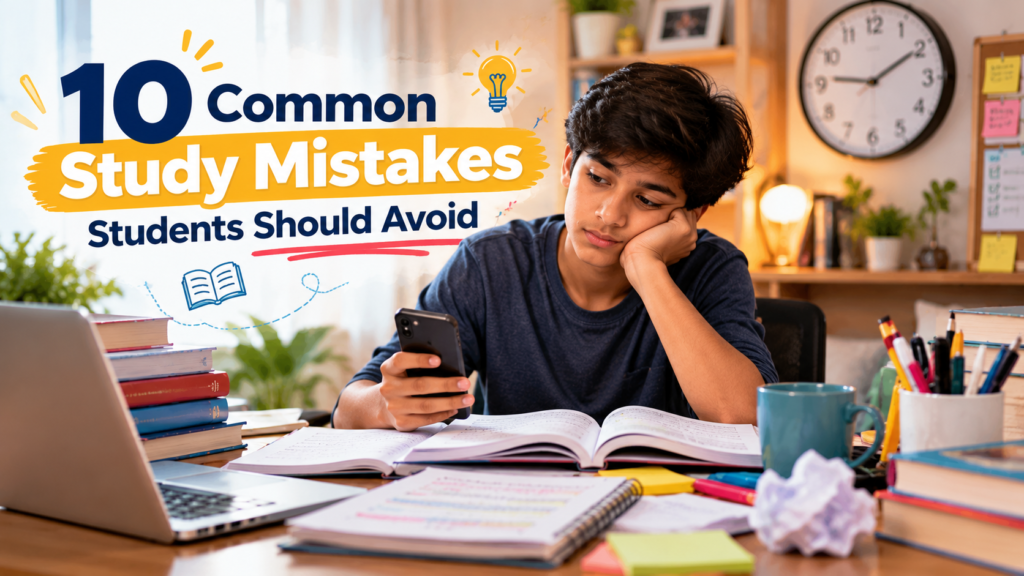
| Common study mistakes students make include rereading instead of self-testing, cramming, studying beside a phone and letting AI answer for you. Each feels productive but weakens learning. Swap them for effective study habits: short spaced sessions, practice quizzes, mixed problem sets, a written plan and full sleep before exams. |
You spent three hours on Chapter 7 last night. The highlighter ran dry and every page turned yellow. This morning, the first question on the test drew a blank. Effort wasn’t the problem. The method was. Many of the habits students rely on most, including rereading, highlighting and last-minute marathons, are the ones learning research rates lowest. This guide covers ten common study mistakes, what studies from 2021 to 2026 say about them and a fix for each that you can try in your next session.
What Are the Most Common Study Mistakes Students Make?
Common study mistakes students make fall into two groups. The first is using methods that feel productive but don’t build lasting memory, such as rereading and cramming. The second is working in conditions that undercut learning: a phone on the desk, an AI doing the thinking, no written plan, or a short night’s sleep.
The trouble is that these mistakes feel right. John Dunlosky, who led a major review of study techniques, notes that students often believe relatively ineffective strategies are actually the most effective.
Here are all ten at a glance:
| # | Study mistake | Better habit |
| 1 | Rereading and highlighting | Close the book and recall |
| 2 | Cramming the night before | Spread sessions across days |
| 3 | Phone within reach | Phone in another room |
| 4 | One problem type at a time | Mixed problem sets |
| 5 | Judging readiness by familiarity | Answer questions without notes |
| 6 | Memorising without asking why | Explain each step to yourself |
| 7 | Letting AI give answers | Ask AI for hints only |
| 8 | Cutting sleep to study | Keep the sleep window fixed |
| 9 | Studying only when a test is announced | Weekly study blocks for every subject |
| 10 | Ignoring mistakes on marked work | Keep an error log and retest |
What Does Recent Research Say About Study Mistakes?
Recent research sharpens the warnings about study mistakes. A 2025 field experiment found students who leaned on a ChatGPT-style tutor scored 17% lower than peers once access was removed. A 2023 meta-analysis found practice quizzes reduce test anxiety. PISA 2025, released in September 2026, again linked heavy device use and distraction to weaker results.
2025 Field Experiment: AI Help Can Become a Crutch
Bastani and colleagues gave nearly a thousand high-school maths students in Turkey access to GPT-4 tutors. With the plain ChatGPT-style version open, grades on practice problems rose 48%. When access was removed, those students scored 17% lower than students who never had the tool.
- The authors write that students used the unguarded tool as a “crutch” during practice and then performed worse on their own. The study was published in PNAS in June 2025.
- A high practice score with AI open is a poor guide to what you can do alone in the exam hall.
- It’s one school and one subject, so treat the size of the effect as specific to that setting. The direction of the finding is the useful part.
2023 Meta-Analysis: Practice Quizzes Lower Test Anxiety
A 2023 meta-analysis in Educational Psychology Review pooled 24 studies with 3,374 participants and found that practice tests reduced test anxiety to a medium extent. That answers a worry teachers often raise, that quizzes make students more anxious. The authors recommend building quizzes into regular learning.
- The review by Yang, Li, Zhao, Luo and Shanks reports strong Bayesian evidence and minimal publication bias for the anxiety-reducing effect.
- The authors add a caution: quizzes themselves may feel more stressful than other study activities. They also note that research on this question is still young.
PISA 2025: Heavy Device Use and Distraction Go With Weaker Scores
The PISA 2025 results, published in September 2026, linked moderate use of digital devices for learning with stronger science performance and heavy use with weaker outcomes. Students who didn’t use AI chatbots for schoolwork generally scored higher and reported seeking help more often than students who did.
- More than one in four students said classmates were distracted by devices in most or every science lesson, according to Education International’s summary of the release.
- These are associations across countries, not proof that chatbots cause lower scores. They match what the 2025 field experiment found in a controlled setting.
10 Common Study Mistakes and How to Fix Them
Each of the ten mistakes to avoid while studying below includes the evidence behind it and a fix to try in your next session. You don’t need to fix all ten at once. Pick the two that describe your week best and start there.
1. Rereading and Highlighting Instead of Testing Yourself
Rereading and highlighting feel like work, but a review of ten study techniques rated both low for lasting learning. Testing yourself does better. In fact, quizzing raises achievement to a medium level too.
- Highlighting can even backfire. In one study Dunlosky describes, students who highlighted while reading did worse on comprehension questions that required connecting ideas across the text.
- The fix is to read a section, close the book and write down everything you remember. Then open the book and fill the gaps in a different colour. The gaps show you what to restudy.
2. Cramming the Night Before an Exam
Cramming packs all study into one session and it works just well enough to feel reliable. Students retain knowledge longer when they spread practice across sessions, even when the total time is the same. Two shorter sessions several days apart usually serve better than one long night.
- Dunlosky gives the example of an eighth-grader preparing for a geology exam. Studying notes one evening several days before, then again the evening before, beats one long night of rereading.
- Try a three-touch rule: study a topic the day it’s taught, again two or three days later and once more the evening before the test.
3. Studying With Your Phone Within Reach
A phone within reach turns a study session into a string of interruptions. In a study, students distracted in most or every maths lesson scored 15 points lower than peers who rarely were. So, put the phone in another room.
- Smartphones carry a higher distraction risk than educational software.
- Rules alone often fail. The fix is distance. Charge the phone outside the room, use a basic kitchen timer and check messages only during breaks.
4. Practising One Type of Problem at a Time
Doing ten identical problems in a row lets you copy the steps without learning when to use them. Students who mixed four problem types tend to do three times better on a test a week later than students who practised each type in its own block.
- The block-practice group actually scored higher during practice. That early success is what makes blocking feel effective.
- Mixing doesn’t help every subject. In the studies Dunlosky cites, it made no difference for French vocabulary grouped by category or for comma rules. Use it mainly for maths and science problems.
- To fix this, after finishing an exercise, make a mixed set of five questions from the last three chapters and solve them in random order.
5. Judging Readiness by How Familiar Your Notes Feel
Familiar notes feel like knowledge, but recognising a page is easier than recalling it on a blank exam sheet. The quick fluency students gain from massed study is often short-lived, which is why it misleads them. Check readiness by answering questions without looking.
- Studies suggest that students benefit most from practice that requires recall from memory, not from tests that only ask them to recognise the right answer.
- A fast readiness check is to explain the topic out loud in two minutes, without notes, to a sibling, a parent or an empty chair. The places where you stall are the places to revise.
6. Memorising Facts Without Asking Why
Memorising a fact without understanding it works until a question is phrased differently. Asking “why is this true?” or explaining how a step connects to what you already know helps with new problems. In one experiment on logical reasoning, students who explained their steps scored about 90% versus under 30% for others.
- Self-explanation doesn’t change scores during practice. It paid off on new problems that required transfer.
- Studies rate these methods “promising” rather than top-tier and they’re harder when you know little about a topic yet. Use them once the basics are in place.
- To fix this, write “because…” after each step of a solved maths problem, or add one “why” question beside every fact in your notes.
7. Letting AI Tools Do the Thinking
Asking a chatbot for finished answers raises practice scores and can lower real skill. In the 2025 PNAS experiment, a tutor version set up to give teacher-designed hints instead of answers lifted practice grades 127%. It also largely avoided the later drop seen with the plain tool. Use AI for hints only.
- The authors found the negative learning effects were largely mitigated by the safeguards in the hint-based tutor.
- Try a hint-first routine. Attempt the question alone for ten minutes. If you’re stuck, ask the AI “what is the first step?” rather than “solve this.” Then redo the full problem later without any help.
8. Trading Sleep for Extra Study Hours
Staying up late to study borrows from tomorrow’s attention. The American Academy of Sleep Medicine recommends 8 to 10 hours of sleep for teenagers. In a small experiment its panel cites, 16 adolescents limited to 6.5 hours for five nights showed poorer attention and learning in a simulated classroom than after 8 hours.
- The same consensus statement recommends 9 to 12 hours for children aged 6 to 12 and links regular short sleep to attention and learning problems.
- The fix is to schedule the last review of the day for early evening and treat bedtime as part of the study plan. An all-nighter before an exam is the worst version of this mistake.
9. Studying Only When a Test Is Announced
Waiting for a test date leaves cramming as the only option. Setting study blocks throughout every week helps. Even two short blocks per subject may be enough to learn new material and revisit old material. Students must keep a planner that maps sessions before each exam.
- Many students start preparing only when reminded the exam is tomorrow and by then cramming is the only choice left.
- To fix this, spend fifteen minutes every Sunday writing next week’s study blocks into a planner, with each subject appearing at least twice.
10. Ignoring Mistakes on Marked Tests and Homework
A marked test is free information about what to study next, yet it can go straight into the bag. Dunlosky explains that failing to recall an answer signals what needs restudying. A 2021 meta-analysis found corrective feedback was one of the factors shaping how much quizzing helped.
- Keep an error log with three columns: the question, why you got it wrong and the correct method. Revisit the log a week later and retry the questions cold.
- Sort errors by type. A careless slip needs a checking habit. A concept gap needs restudy.
How Do You Replace Study Mistakes With Effective Study Habits?
Replace one study mistake at a time with its matching habit and keep the rest of your routine unchanged. One weekly pattern to try: learn new material early in the week, quiz yourself midweek, mix problem types on the weekend and review marked work every Sunday.
This week-long pattern swaps each mistake for an effective study habit:
| Day | Effective study habit | Mistake it replaces |
| Monday | Learn new topics, then write what you recall | Rereading and highlighting |
| Tuesday | Revisit Monday’s topics for 15 minutes | Cramming |
| Wednesday | Self-quiz on the week so far, phone in another room | Phone within reach, judging by familiarity |
| Thursday | Explain two solved problems step by step | Memorising without asking why |
| Friday | AI for hints only on hard questions | Letting AI give answers |
| Saturday | Mixed problem set from three chapters | One problem type at a time |
| Sunday | Error log review and next week’s plan | Ignoring mistakes, no plan |
To Sum Up
Common study mistakes share one trait: they feel productive in the moment and leave little behind a week later. Pick the two mistakes you recognise most and swap in their fixes for the next fortnight, then add another. Judge progress by what you can recall without notes.
Ask yourself these questions at the end of each week:
- Can I write the main points of this week’s topics from memory?
- Did any subject get studied only once?
- Was my phone out of the room for most sessions?
- Did I redo last week’s wrong answers without looking?
Frequently Asked Questions About Common Study Mistakes
Why Does Effective Studying Feel Harder Than Rereading?
Ans. Effective methods feel harder because they make you face what you’ve forgotten. Learning feels tougher when practice is spread out, while the quick fluency from massed study is often short-lived. A failed attempt to recall an answer isn’t wasted time either. It tells you exactly what to restudy. So the struggle is a sign the method is working, not a sign you’re doing badly.
Is Highlighting Always a Study Mistake?
Ans. Not entirely. Highlighting is only the first step. It must be followed by methods that work better, such as self-testing to make overall studying effective.
Are Easy Practice Quizzes Better Than Hard Ones?
Ans. For anxious students, starting easy helps. Studies suggest that easy practice tests reduce test anxiety more than difficult ones. The authors also warn that quizzes can feel more stressful than other study activities. A practical approach is to begin with quizzes you can mostly answer, then raise the difficulty as confidence grows.
Can You Fix Study Mistakes a Week Before an Exam?
Ans. You can fix several of them. Switch today from rereading to closed-book recall and split the remaining days so every topic comes up at least twice. Keep bedtime fixed, since the sleep panel’s evidence ties short nights to poorer attention and learning in teenagers. Spacing works best with more lead time, so start the next term’s revision earlier.
Does Studying Longer Make Up for Using the Wrong Method?
Ans. Often it doesn’t. Spread-out study beats massed study even when the total time is the same. Studies have revealed that in a mixed-practice study, two groups solved the same number of problems, yet the mixed group did three times better a week later. The method changes the result at a fixed number of hours.